The UK sun tunnel buying guide
Best sun tunnels in the UK: choose the right daylight specification
The best sun tunnel for your home is the one that brings useful daylight to the right place and fits your roof properly. Compare the collector, tube route, thermal specification and complete installed cost. Intura SunTube combines a premium glass dome on ST25/ST35 with a rigid mirror tube and an optional EcoPower insulation upgrade.
Intura Daylight Systems Ltd · UK daylight products and project support
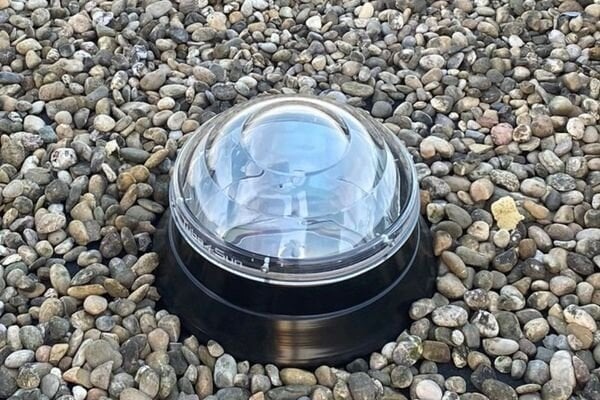
What makes a good sun tunnel?
Start with the room, not a product code. Is the problem a gloomy landing, a windowless bathroom or the back of a deep extension? A sun tunnel collects outdoor daylight and sends it through a tube to a ceiling diffuser. It is particularly useful when the room and the best position on the roof do not sit directly above one another.
Look beyond a single headline percentage. The collector determines what enters the system; the tube determines how much survives the route; the diffuser determines how it spreads across the room. A well-positioned smaller system can be more useful than a larger one installed in persistent shade.
- Roof match: choose the correct external unit and flashing for the actual roof covering.
- Route: measure the full distance and identify bends before choosing a diameter.
- Daylight distribution: decide whether one central diffuser or several spaced units will better serve the layout.
- Thermal detail: compare the complete assembly and its connection to the insulated building envelope.
- Ownership: consider cleaning access, replacement parts and a clearly itemised quote.
For the roof-specific choices, explore flat roof sun tunnels and pitched roof sun tunnels. If you are still working out the budget, use our sun tunnel cost guide.
Why choose Intura SunTube for your project?
A useful shortlist starts with a complete specification. Intura SunTube brings together the roof collector, a rigid mirror tube, a ceiling diffuser and a choice of roof connections. The options let you specify daylight, roof compatibility and insulation as one system, instead of deciding on each component in isolation.
| Feature | Intura SunTube option | What to check for your project |
|---|---|---|
| Crystal glass collector | ST25 and ST35 use a crystal glass dome; ST55 uses acrylic. | Confirm the chosen diameter and collector material in the quote. |
| Rigid mirror tube | Published tube reflectivity of 99.8%, with extensions and adjustable elbows. | Plan the shortest practical route and include every required section. |
| Flat roof connections | Variants with pre-fitted EPDM, bitumen or PVC roofing material. | Match the variant to the existing membrane and the roofer’s joining detail. |
| Pitched roof connection | Pre-fitted Leadax flashing for the pitched roof configuration. | Check the roof covering, pitch and build-up against the installation instructions. |
| EcoPower insulation | Optional double- or triple-glazed insulation elements. | Specify the correct diameter, glazing and complete thermal junction. |
The ST25 and ST35 glass collector is a tangible material choice at the top of the system. The rigid mirror tube provides a defined light path beneath it. Pre-fitted roofing materials give the installer a matching starting assembly for the roof connection. Together, these features make SunTube a strong option for a carefully planned daylight project.
For a heated room, the EcoPower option adds another specification decision: the complete assembly can be selected with a documented thermal upgrade. That matters when a daylight opening crosses a well-insulated roof or ceiling. Ask for the exact configuration rather than a general insulation claim.
Rigid or flexible sun tunnel: make the route part of the decision
A rigid system uses smooth reflective sections. A flexible system offers a different way of negotiating an awkward loft. The right question is how efficiently the available route can be built, rather than whether an entire roof space looks complicated.
Before accepting a flexible route, check whether the collector or diffuser can move slightly to create a straighter rigid route. Intura offers extension sections and adjustable elbows, so a change in direction does not automatically rule out a rigid SunTube. Keep unnecessary bends out of the design.
Published Intura tube reflectivity is 99.8%. This is a specification for the reflective tube surface. Delivered daylight also depends on the collector, tube length, bends and diffuser. Plan these together so that a high-performing component is part of an efficient complete route.
Send a roof-to-ceiling sketch to Intura’s UK team and use the installation manuals and technical resources to check the proposed assembly.
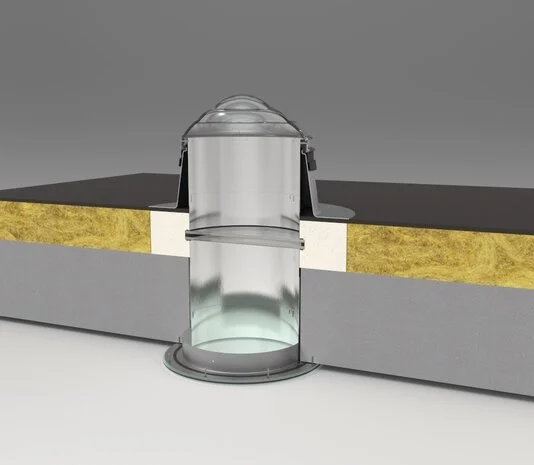
Choose daylight and thermal performance together
Adding a roof penetration deserves the same care as the rest of an insulated roof. Intura’s EcoPower insulation element offers double- and triple-glazed versions. Published Itecons calculations put the triple-glazed ST25, ST35 and ST55 configurations at 0.70, 0.69 and 0.65 W/m²K respectively.
These are configuration-specific system values. They are not the glazing-only Ug value, and they do not establish a whole building’s energy performance. Ask for the full calculation information if an architect or energy assessor needs to use the product in a model.
For a heated room beneath a well-insulated roof, decide the thermal specification before requesting prices. This avoids comparing a basic kit with a configuration with additional insulation. Proper detailing at the insulation and air barrier remains part of the installation.
Which Intura SunTube should you shortlist?
SunTube25
A starting point for smaller rooms where the route and available roof space suit a 250 mm tube.
SunTube35
A 350 mm option to discuss for landings, bathrooms and rooms requiring a larger daylight opening.
SunTube55
A 550 mm system for larger spaces and project layouts. Its external dome is acrylic.
If your immediate problem is an internal circulation space, our guide to sun tunnels for hallways and landings explains positioning. Where a roof route cannot work, ask about the SunTube side wall system.
Frequently asked questions
What is the best sun tunnel in the UK?
There is no single model that wins for every building. Choose by roof compatibility, route, required daylight, thermal specification and total fitted cost. Intura SunTube is a compelling option when you want the ST25/ST35 glass dome, a rigid tube and the EcoPower upgrade in one product family.
What does 99.8% tube reflectivity mean?
It describes the published reflective performance of Intura’s mirror-tube surface. It is not the percentage of outdoor daylight delivered into a room. The collector, route length, bends and ceiling diffuser all affect the complete result.
Will a sun tunnel work on a cloudy day?
It can collect diffuse daylight under cloud, but output changes with weather, season, shading and the tube route. Keep electric lighting available for low-light periods and after dark.
Does every Intura SunTube have a glass dome?
ST25 and ST35 use crystal glass. ST55 uses an acrylic dome. Check the exact model and roof configuration in the quote.
Can a sun tunnel replace a roof window?
It can solve a daylight problem where a roof window is difficult to position. It does not provide an outside view, an opening for ventilation or an escape route. Decide which functions the room actually needs.
Find the right SunTube for your roof
Send the roof type, room dimensions, roof-to-ceiling distance and a few photos. We can help you shortlist a suitable configuration.
Prefer to call? +44 1932 731759
Product information and sources · Prepared for Intura Daylight Systems Ltd. Product information checked 29 September 2026.